Living in Back Bay: The Essential Guide for Young Professionals
Explore Back Bay’s polished urban vibe: 100 Walk Score, Green/Orange Line access, $3,350 1-bed rents, brownstone condos and Newbury Street life.
Written ByCorey Stallings
PublishedSeptember 3, 2026
I'm Corey Stallings, a Boston real estate agent with eXp Realty serving buyers and sellers across Boston, Quincy, Randolph and Dedham. Let's win your next move. Serving Boston, Randolph, Dedham and Quincy, MA.
Back Bay is Boston at its most polished. Nineteenth-century brownstones line grid-perfect streets, a world-class shopping corridor unfolds just steps from the Charles River, and the whole neighborhood feels like it was designed to be walked. For young professionals, it's one of the rare corners of the city where you can walk to work, walk to dinner, and walk to a Sunday morning run along the water — no car required. Before you make the move, here's what actually matters.
What Is the Vibe Like in Back Bay?
Back Bay is high-energy, sophisticated, and unapologetically urban — though its historic elegance takes the edge off the pace. This is the neighborhood for people who want their city living polished, walkable, and social.
Everything orbits the Newbury and Boylston Street corridors, where cafes spill onto patios, boutiques stay busy, and foot traffic hums well into the evening. This is not a sleepy residential pocket. It's a place built for people who want to be in the action. Newbury Street alone has seen foot traffic climb roughly 40%, and its retail vacancy sits near 1% — a good measure of how alive the street level feels day to day.
What keeps the buzz in check is the neighborhood's built-in release valve: the Charles River Esplanade. On any given morning, you'll find residents running, biking, and rowing along the water. The health-conscious lifestyle here is real, not aspirational. Meanwhile, the Commonwealth Avenue Mall runs a tree-lined green spine straight through the neighborhood, offering a genuine outdoor breather in the middle of all that density.
The demographics tell the same story. With a median age around 35 and a median household income near $128,700, Back Bay skews toward educated, career-driven residents — roughly 74% of adults hold a bachelor's degree or higher. It's a neighborhood of professionals, and it feels like one.
One honest caveat I always raise when walking clients through the area: this is a loud social scene by design. If you're touring a condo directly above a Boylston Street restaurant, ask about noise. Many of the corridor's most popular spots run at "very loud" levels deep into the night — perfect for going out, worth thinking twice about for where you sleep.
What Are Condos and Townhomes Like in Back Bay?
Back Bay real estate comes down to two things: iconic Victorian brownstones and modern full-service luxury towers — both commanding premium prices. This is one of Boston's most expensive and tightly held markets, and inventory is genuinely limited.
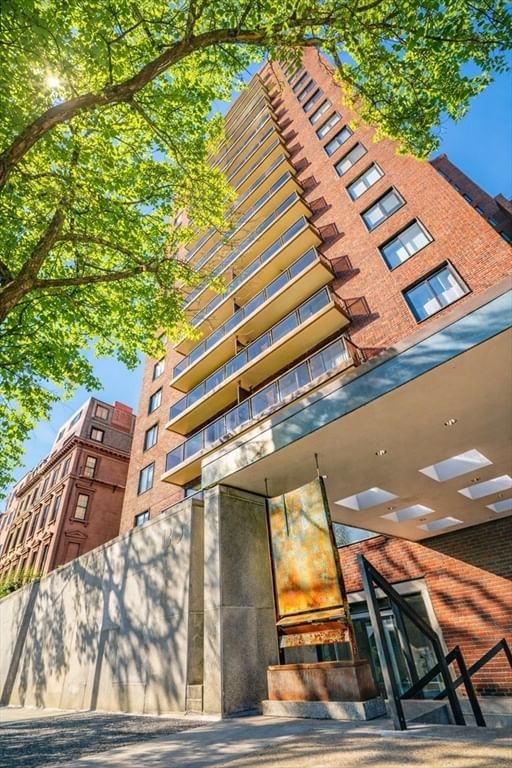
The brownstones are the neighborhood's signature. Many of these historic townhomes have been converted into multi-family luxury condos, with high ceilings, bay windows, decorative fireplaces, and that unmistakable period character. At the other end of the spectrum, high-rise developments like One Dalton deliver concierge service, skyline views, fitness centers, and the kind of turnkey amenity package that appeals to buyers who don't want to lift a finger.
Here's where things stand as of August 2026:
Back Bay Housing Market Snapshot: August 2026
Headline ownership-market indicators for Back Bay, including pricing, inventory, days on market, and sale-to-list context. These figures are sourced directly from the available neighborhood market dataset rather than inferred from an empty primary fact bank.
A few numbers stand out. The median listing price sits around $2,200,000, while the median sold price is closer to $1,275,000 — a gap that reflects how much ultra-luxury inventory pulls the top end upward. Price per square foot runs about $1,443, among the highest in the city. And with roughly 199 active listings and a median 66 days on market, this reads less like a frenzied market and more like one where buyers can actually breathe.
That breathing room matters. Unlike the bidding wars I've navigated in tighter, lower-priced pockets of Greater Boston, Back Bay buyers can generally take their time. Homes here trade close to asking — the neighborhood's sale-to-list ratio has been sitting around 98% — but with two-plus months of activity on the market, you're rarely forced into a snap decision.
For young professionals, the entry point is key. While headline luxury listings climb into eight figures, the practical door into the market opens much lower — smaller studios and one-bedrooms have historically started in a more attainable range, and plenty of buyers get their foot in with a compact condo before trading up.
One insider note on carrying costs: the full-service buildings that make Back Bay so appealing come with real HOA fees. In the luxury tier, monthly condo fees frequently run $2,000–$4,000, covering concierge, security, and amenities. Always underwrite the total monthly cost — fees plus taxes plus utilities — not just the mortgage.
Should You Rent or Buy in Back Bay?
For many young professionals, renting is the smart first move into Back Bay. It gets you the lifestyle without the steep buy-in. The rental market here runs deep and, notably, prices out below some of the newer waterfront neighborhoods.
Back Bay's median one-bedroom rent sits around $3,350/month. Premium, yes — but not the top of the Boston market. Both Seaport and the South End run higher.
Median 1BR Rent: Back Bay vs. Other Young-Professional Neighborhoods
A same-unit rent comparison showing Back Bay’s median one-bedroom rent at $3,350, distinct from separate overall-average rent datasets. This reconciles the prior $3,436 vs. $3,350 mismatch by using the neighborhood-comparison source consistently for this chart.
A same-unit rent comparison showing Back Bay’s median one-bedroom rent at $3,350, distinct from separate overall-average rent datasets. This reconciles the prior $3,436 vs. $3,350 mismatch by using the neighborhood-comparison source consistently for this chart.
Broken out by unit type, the ranges land where you'd expect for a high-demand core neighborhood. Studios and one-bedrooms are where most young professionals settle, while two-bedrooms move into "splitting with a roommate" territory. The market has been remarkably stable, with rents ticking up only modestly year over year — the signature of a mature, established neighborhood rather than a volatile one.
The rent-versus-buy math here is genuinely close, and it really comes down to timeline. If you expect to stay put for five-plus years and you can absorb the HOA and tax load, buying a brownstone condo builds equity in one of the most enduring markets in the country. If your career might pull you elsewhere in a couple of years, renting keeps you flexible and lets you enjoy the neighborhood without the transaction costs.
What Are the Best Landmarks and Social Hubs in Back Bay?
Back Bay's social life revolves around three anchors: Newbury Street, Copley Square, and the Prudential/Copley Place retail hubs. This is where residents shop, work, meet friends, and unwind.
Newbury Street is the headline — eight blocks of boutiques, galleries, cafes, and patio dining that function as the neighborhood's living room. It's the kind of place where a coffee run becomes an afternoon. Whether you're grabbing a quick bowl at sweetgreen between meetings or lingering over cocktails at Joe's on Newbury , the street sets the neighborhood's rhythm.
Copley Square is the civic and architectural heart, home to the historic Boston Public Library and Trinity Church. The library's courtyard is one of my favorite quiet-in-plain-sight spots in the city — a real escape just a block off the busiest streets. Copley Square Park hosts a farmers market and serves as the neighborhood's natural gathering point.
The Prudential Center and Copley Place round things out as the indoor retail and business hubs — connected, weatherproof, and endlessly useful when Boston winters bite. Both have posted strong foot traffic gains lately (the Pru up around 36%), which underscores just how commercially healthy this core stays.
And for the fitness-minded crowd that defines Back Bay, the options are dense: boutique studios like Barry's and full-service gyms are packed into a few walkable blocks, feeding straight into that active, health-conscious identity.
How Is the Commute from Back Bay to Downtown Boston and Cambridge?
Back Bay has one of the best transit and walkability profiles in all of Boston — most residents don't need a car, and many don't own one. If a car-light life is the goal, this is arguably the single best neighborhood in the city for it.
The numbers make the case. Back Bay carries a perfect 100 Walk Score, a near-perfect 97 Transit Score, and a strong 86 Bike Score.
Back Bay Mobility Scores
Back Bay’s walk, transit, and bike scores reinforce the neighborhood’s car-light appeal for young professionals who want daily errands, offices, nightlife, and rail access close by.
Back Bay’s walk, transit, and bike scores reinforce the neighborhood’s car-light appeal for young professionals who want daily errands, offices, nightlife, and rail access close by.
•Green Line: The Copley, Arlington, and Hynes Convention Center stations put you on the Green Line for quick trips downtown, to the theater district, or out toward Fenway.
•Back Bay Station: This is the workhorse — Orange Line service, Commuter Rail, and Amtrak all under one roof. It handles roughly 64,000 daily passenger trips, making it your gateway to the Financial District, the suburbs, and the entire Northeast Corridor.
•Walking: With a perfect Walk Score, most daily errands — groceries, pharmacy, gym, dinner — happen on foot. The Dartmouth Street sidewalk alone sees 70,000+ daily pedestrian trips.
•Biking: The recently completed Boylston Street mobility project has strengthened the neighborhood's bike infrastructure, and Boston's Bluebikes network logs around 4.7 million rides a year.
Boylston Street Back Bay Project
A completed public-realm and mobility project on Boylston Street, useful context for buyers and renters prioritizing safer bike access, better sidewalks, and urban connectivity.
Current PhaseComplete
Year Completed2024
Street SegmentBoylston Street between Massachusetts Avenue and Arlington Street
For Cambridge commuters, the walkability and Green Line connections make cross-river trips very manageable, and the Esplanade footbridges give cyclists a scenic route across the Charles. Roughly 35% of Back Bay residents walk to work, and about half don't own a car at all — a statistic that says everything about how this neighborhood is meant to be lived.
The Bottom Line for Young Professionals
Back Bay offers a rare combination: historic beauty, a lively social scene, and a transit-and-walkability profile that lets you ditch the car entirely. It's premium — there's no getting around the cost of entry — but it's also a market where buyers and renters have real room to be selective rather than reactive.
If you want to be at the center of Boston's energy, surrounded by brownstone charm and steps from the Charles, few neighborhoods make the case as clearly. Whether you're weighing your first condo purchase or scouting rentals to test the waters, I'm always happy to walk the streets, talk through the tradeoffs, and help you figure out where you fit. Let's talk about your next move.
Is Back Bay in Boston, MA a good place to live for young professionals and families?
Back Bay is best known for polished, walkable city living with a high-energy social scene, historic brownstones, and quick access to the Charles River Esplanade. The neighborhood has a median age around 35, a median household income near $128,700, and a highly educated resident base, with roughly 74% of adults holding a bachelor’s degree or higher.
What types of condos and townhomes are available in Back Bay, Boston, MA?
Back Bay real estate is centered on historic Victorian brownstones and modern full-service luxury towers. Many brownstones have been converted into luxury condos with high ceilings, bay windows, decorative fireplaces, and period character, while newer towers offer concierge service, skyline views, fitness centers, and turnkey amenities.
How much do condos cost in Back Bay, Boston, MA?
As of August 2026, Back Bay’s median listing price is about $2.2 million, while the median sold price is closer to $1.275 million. Price per square foot is around $1,443, placing Back Bay among Boston’s most expensive condo markets.
Are HOA fees high for Back Bay condos in Boston, MA?
HOA fees can be significant, especially in full-service luxury buildings. In the luxury tier, monthly condo fees commonly run about $2,000 to $4,000 and typically cover services such as concierge, security, and amenities.
Is it better to rent or buy in Back Bay, Boston, MA?
Renting is often the smarter first move for young professionals who want flexibility and access to the Back Bay lifestyle without the steep upfront cost of buying. Median one-bedroom rent is about $3,350 per month, while buying generally makes more sense for residents planning to stay five or more years and absorb taxes, HOA fees, and transaction costs.
How is the commute from Back Bay, Boston, MA to downtown or Cambridge?
Back Bay has a 100 Walk Score, 97 Transit Score, and 86 Bike Score, making it one of Boston’s strongest neighborhoods for car-light living. Green Line stations at Copley, Arlington, and Hynes Convention Center provide local transit access, while Back Bay Station connects residents to the Orange Line, Commuter Rail, and Amtrak.
Do residents need a car in Back Bay, Boston, MA?
Most daily needs in Back Bay can be handled on foot, including groceries, gyms, restaurants, pharmacies, and transit. About 35% of residents walk to work, and roughly half do not own a car, reflecting how walkable and transit-oriented the neighborhood is.
What should families know about schools in Back Bay, Boston, MA?
Specific school ratings and assigned school information are not established for Back Bay here. Families considering the neighborhood should verify school assignments by address and evaluate commute, housing costs, and access to parks or outdoor space before deciding.