Boston, MA Neighborhood Guide: The Essential Guide for Young Professionals
Explore Boston’s high-energy, walkable vibe: $794.5K median condo, 82.8 Walk Score, MBTA T access, and top hubs for young professionals.
Written ByCorey Stallings
PublishedSeptember 3, 2026
I'm Corey Stallings, a Boston real estate agent with eXp Realty serving buyers and sellers across Boston, Quincy, Randolph and Dedham. Let's win your next move. Serving Boston, Randolph, Dedham and Quincy, MA.
Boston, MA
Region
10
Villages
In July 2026, the median sale price for homes in Boston, MA was $879,500, up 7.3% from a year earlier.
If you're a young professional thinking about a move to Boston, understand this: you're not just choosing a place to sleep. You're plugging into one of the most compact, walkable, opportunity-rich cities in the country. In my experience showing homes here, the buyers who thrive are the ones who really grasp what makes this city tick — the energy, the housing trade-offs, and the transit web that lets you live car-light. So here's the honest, insider's rundown.
What Is the Vibe Like Living in Boston, MA as a Young Professional?
Boston is high-energy, dense, and walkable — a city where 400-year-old cobblestone streets sit steps from glass biotech towers, and where the pace is set by tech, finance, higher education, and life sciences. It's busy without feeling overwhelming, and remarkably compact for a major metro.
With roughly 692,000 residents packed into about 89 square miles, Boston delivers genuine urban density while still feeling human-scaled. You can walk from a historic North End trattoria to a Seaport rooftop bar in under an hour. What draws young professionals here, specifically, is the sheer concentration of opportunity — Metro Boston is home to 118 colleges and universities, which feed a constant pipeline of talent into the region's dominant tech, finance, and biotech sectors.
The social scene mirrors that ambition. World-class dining, craft breweries, and cultural institutions all cluster within short walks of one another. On any given morning, the Financial District crowd is grabbing coffee at spots like Gracenote Coffee before heading into the office, and by evening those same neighborhoods hum with after-work energy.
A few realities worth knowing up front:
•Cost of living runs high — roughly 66% above the national average, with housing costs about 150% higher. Boston rewards you with density and opportunity, but you pay for the privilege.
•Winters are real — expect around 54 inches of snowfall a year and January highs near 37 degrees. Summers, thankfully, are pleasant, averaging around 73 degrees.
•Education and income skew high — a median household income near $84,000 and one of the most educated populations in the country.
Compared to some of the quieter South Shore communities I also work in — think Quincy, Randolph, or Dedham — the city itself trades space and calm for walkability and immediacy. If you want to step out your door and straight into the action, Boston delivers.
What Are Condos and Townhomes Like in Boston, MA?
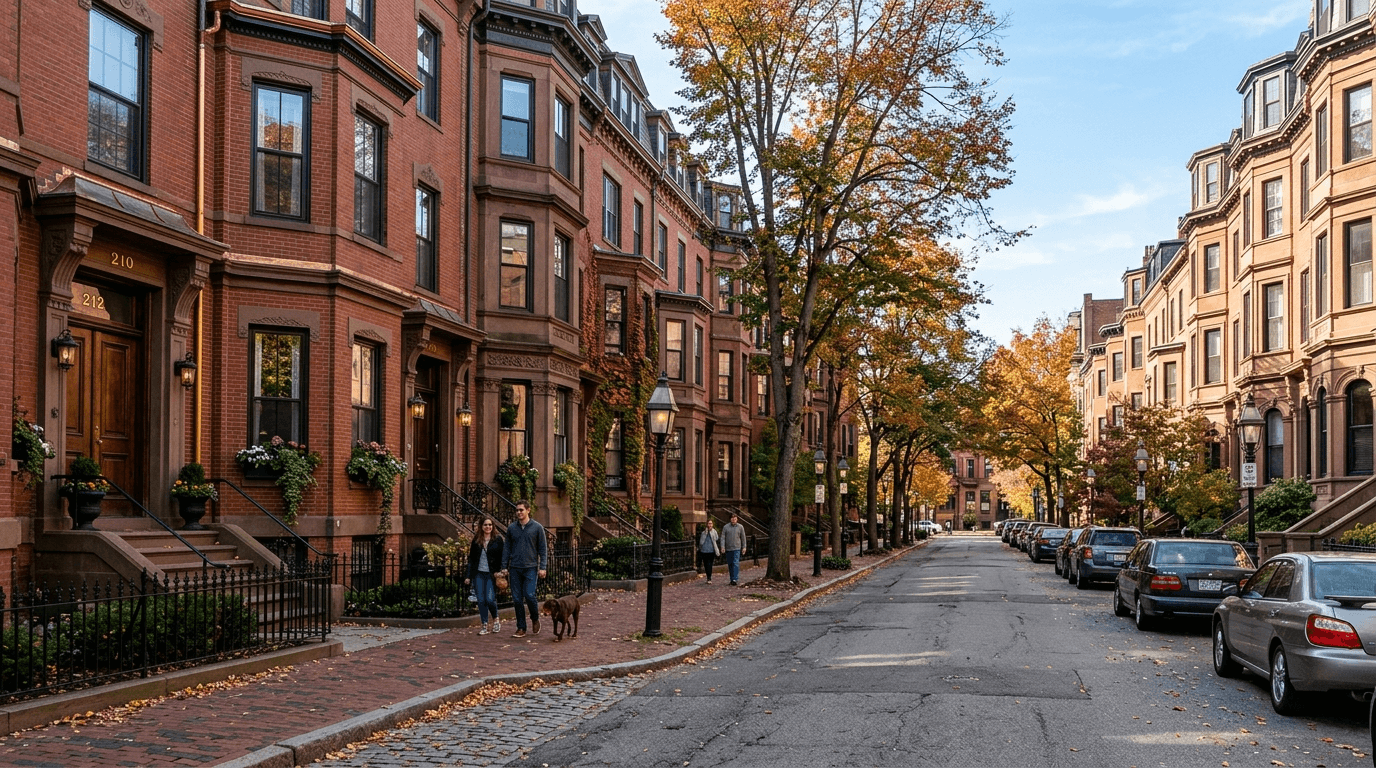
Boston's for-sale market is dominated by condominiums and historic townhome conversions — from Victorian brownstones in the South End to sleek glass high-rises in the Seaport. For most young professionals buying their first place, a condo is the entry point, and the pricing reflects the premium on urban square footage.
Here's where the market stands right now:
Boston Condo Market Snapshot: July 2026
Headline condo/townhouse metrics for young professionals considering an urban Boston purchase, highlighting pricing, speed, supply, and current listing depth.
As of July 2026, the median sold price for a Boston condo or townhouse was $794,500, with a median of 48 days on market and 10.2 months of supply against 3,360 active listings. That inventory level matters. It tells you buyers have genuine choice and room to negotiate right now, rather than the frantic, sight-unseen bidding wars we saw in tighter years. For a first-time buyer, that's actually good news — you can afford to be selective.
Architecturally, the city is a patchwork:
•South End & Back Bay: Iconic brick and brownstone facades, bow-front Victorians, and walk-up conversions with original detail intact.
•Seaport District: Contemporary glass towers with concierge service, gyms, and common roof decks.
•Beacon Hill & Charlestown: Historic charm, gas lamps, and tight, character-rich units.
Pricing varies dramatically by neighborhood, and this is where strategy matters most:
Boston Condo Neighborhood Price Leaders and Entry Points
Median condo sale prices across selected Boston neighborhoods, showing the gap between luxury urban cores and more accessible city neighborhoods.
Median condo sale prices across selected Boston neighborhoods, showing the gap between luxury urban cores and more accessible city neighborhoods.
The gap is enormous. Luxury cores like Midtown and the Seaport push past $2.3M, and Back Bay sits around $1.61M. But neighborhoods like Allston ($520,000) and West Roxbury ($507,500) offer real entry points for buyers willing to trade a marquee zip code for value. When I work with first-time buyers, we almost always start the conversation right here — matching your budget to the neighborhoods where it actually stretches.
One thing you absolutely must factor in: lot sizes are minimal to nonexistent. You're buying square footage and location, not a yard. The trade-off is amenities — concierge, shared roof decks, fitness rooms — and those come with monthly HOA fees. Across the Boston metro, the median condo HOA fee runs about $386/month, and nearly 30% of owners pay more than $500/month. Always underwrite the full carrying cost, not just the mortgage. The fee, the taxes, and the insurance add up fast in this city.
If you're renting first — a smart move for many newcomers — rents vary widely by neighborhood too:
Average 1-Bedroom Rents in Popular Boston Neighborhoods
A focused rent comparison for neighborhoods commonly considered by students and young professionals, using only one-bedroom monthly rent figures.
A focused rent comparison for neighborhoods commonly considered by students and young professionals, using only one-bedroom monthly rent figures.
Fenway/Kenmore commands premium one-bedroom rents around $3,438/month, while Jamaica Plain ($2,850) and Dorchester ($2,380) give you more breathing room. Renting for a year is often the best way to learn which neighborhood actually fits your commute and lifestyle before you commit to buying.
Where Do Young Professionals Gather in Boston, MA?
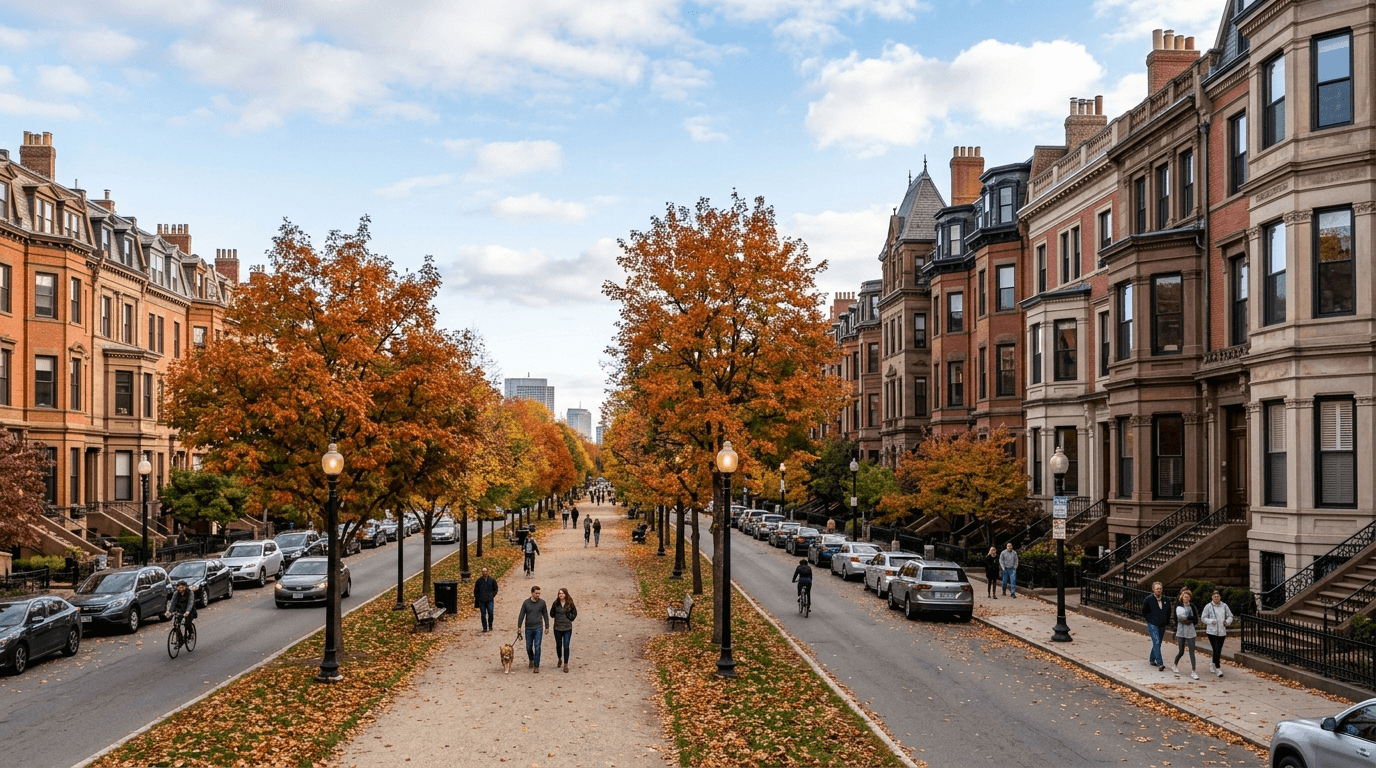
Boston's social and recreational life clusters around a handful of iconic corridors and green spaces — Newbury Street, the Charles River Esplanade, Boston Common, and the Seaport waterfront. These are the places where the young professional community shops, runs, networks, and unwinds.
The essentials:
•Newbury Street & the Prudential Center: The premier shopping and dining spine, lined with sidewalk cafes and boutiques. Retail here is fiercely competitive — Newbury Street vacancy runs under 2%, which tells you just how much demand concentrates on this one stretch.
•The Charles River Esplanade & Boston Common: The city's outdoor living room. Running paths, seasonal events, and green space that make car-free weekends genuinely enjoyable.
•The Seaport District: Innovation-economy office hubs paired with harbor-view rooftop bars. This is the go-to after-work scene for the tech and finance crowd.
Downtown and the Financial District have quietly become excellent for daily living, too. Pocket parks like Norman B. Leventhal Park at Post Office Square give office workers a green break in the middle of the concrete, and the Rose Fitzgerald Kennedy Greenway threads a ribbon of parkland through the heart of the city. For groceries, Roche Bros. Downtown Crossing anchors the residential core, so you're not hauling bags across town.
Here's what I tell newcomers: pick a neighborhood by the life you want to walk to. In Boston, your daily radius matters more than your square footage.
How Is the Commute in Boston, MA and Is It Walkable?
Boston is one of the most walkable and transit-connected cities in America, built around the MBTA "T" subway — the Red, Green, and Orange lines — plus commuter rail hubs at South Station and Back Bay Station. For young professionals commuting to the Financial District or Kendall Square, you can absolutely live here without a car.
The numbers back it up:
Boston’s Urban Mobility Scores vs. Other Walkable Cities
Boston ranks highly among major U.S. cities for walkability, transit, and biking—key lifestyle signals for car-light young professionals.
Walk Score
Transit Score
Bike Score
Boston ranks highly among major U.S. cities for walkability, transit, and biking—key lifestyle signals for car-light young professionals.
Boston posts a Walk Score of 82.8, a Transit Score of 72.4, and a Bike Score of 69.4 — putting it in the same conversation as New York and San Francisco for car-light living. That's a genuine lifestyle advantage, and it's one of the biggest reasons my buyers choose the city over the more car-dependent suburbs.
Here's how the transit picture breaks down:
•The T (subway): The Red Line connects downtown to Cambridge and Kendall Square — critical if you work in biotech or tech. The Green and Orange lines cover Back Bay, Fenway, the South End, and beyond.
•Commuter rail & Amtrak: South Station and Back Bay Station are your regional gateways, connecting to the wider suburbs and the Northeast Corridor. It's also how many of my South Shore buyers in Quincy or Dedham reverse-commute into the city.
•Bluebikes: The city's bike-share network is extensive and genuinely useful for short hops, especially in the warmer months.
Two honest caveats. First, if you do drive, the congestion is real — Boston drivers lose roughly 79 hours a year to traffic, though that figure has been trending down. Second, the T has its off days, and buyers coming from car-centric cities need to build in a little patience. But the trade-off is a city where you can genuinely ditch the car payment, the parking headache, and the insurance.
The good news for the long term? The Boston region is investing heavily in mobility. The current five-year Transportation Improvement Program dedicates significant funding to street, transit, and bike upgrades.
FFYs 2027–31 Boston Region MPO Regional Target Investment
A major five-year transportation investment program shaping mobility, streets, bikeshare, pedestrian access, and transit upgrades across the Boston region.
Complete Streets$356,736,419
Major Infrastructure—Roadway$202,084,845
Transit Transformation (allocated)$94,568,883
Bicycle Network and Pedestrian Connections$43,595,151
With over $781 million in regional target dollars programmed — including major spending on Complete Streets, transit transformation, and bikeshare support — the infrastructure that makes car-light living possible is only getting stronger.
A final word from someone who works this market every day: Boston rewards buyers who do their homework. The gap between a $520,000 Allston condo and a $2.3M Seaport unit isn't just money — it's a completely different lifestyle and commute. With inventory sitting healthier than it has in years, right now is a genuine window to be selective rather than desperate. Whether you're renting to test-drive a neighborhood or ready to buy your first condo, the key is matching your budget, your commute, and your daily walking radius. Get those three right, and this city delivers like few others in the country.
Local Spots & Favorites
Boston Market Statistics
Median sale price, days on market, and closed sales by property type.
In July 2026, the median sale price for homes in Boston, MA was $879,500, up 7.3% from a year earlier.
Is Boston, MA a good place for young professionals to live?
Boston, MA is a high-energy, dense, and walkable city with strong access to jobs in tech, finance, higher education, and life sciences. Its compact layout makes it possible to live close to restaurants, offices, transit, parks, and waterfront areas without relying heavily on a car.
Is Boston, MA family-friendly if you want walkability and city amenities?
Boston, MA can work well for residents who value walkability, transit access, green spaces, and daily convenience. Boston Common, the Charles River Esplanade, the Rose Fitzgerald Kennedy Greenway, and neighborhood pocket parks provide outdoor space within the urban core. The main trade-off is space: many homes have minimal or no lot size, and buyers often prioritize location and amenities over private yards.
What are condos and townhomes like in Boston, MA?
Boston’s for-sale housing market is dominated by condominiums and historic townhome conversions. Options range from Victorian brownstones and walk-up conversions in areas like the South End and Back Bay to modern glass high-rises with concierge service, gyms, and roof decks in the Seaport.
How much do condos and townhomes cost in Boston, MA?
As of July 2026, the median sold price for a Boston condo or townhouse was $794,500, with a median of 48 days on market. Prices vary widely by neighborhood, from entry points such as Allston around $520,000 and West Roxbury around $507,500 to luxury areas such as Back Bay around $1.61 million and the Seaport and Midtown above $2.3 million.
How much are HOA fees for Boston, MA condos?
Across the Boston metro, the median condo HOA fee is about $386 per month, and nearly 30% of owners pay more than $500 per month. Buyers should evaluate the full monthly carrying cost, including the mortgage, HOA fee, taxes, and insurance.
What should buyers know about schools and education in Boston, MA?
Boston, MA is part of a major education hub, with Metro Boston home to 118 colleges and universities. The city also has one of the most educated populations in the U.S., and its higher-education network helps support the region’s tech, finance, and biotech job markets.
Can you live in Boston, MA without a car?
Yes. Boston, MA is one of the most walkable and transit-connected cities in the country, with a Walk Score of 82.8, Transit Score of 72.4, and Bike Score of 69.4. The MBTA Red, Green, and Orange lines, commuter rail hubs at South Station and Back Bay Station, and Bluebikes make car-light living realistic for many residents.
What is the commute like in Boston, MA?
Boston’s transit network is built around the MBTA subway system, with the Red Line connecting downtown to Cambridge and Kendall Square and the Green and Orange lines serving areas such as Back Bay, Fenway, and the South End. Driving can be difficult because congestion is real, with Boston drivers losing roughly 79 hours per year to traffic.